
Date: 2020 - 2022
Role: Senior Product Designer / Design Team Manager
Role: Senior Product Designer / Design Team Manager
Executive Summary
Problem: In Q4 2020, the Allstate account was in jeopardy due to significant front end defects and branding inconsistencies. The project faced a high risk of rejection, which would have resulted in either delayed implementation and substantial revenue loss or termination of contract.
Action: I took over as Lead Designer to perform a rescue operation. I conducted a comprehensive design QA audit, resolved critical defects, and executed a strategic whitelabeling of the LifetimeACQUIRE product to align with Allstate’s brand while ensuring WCAG AA accessibility standards.
Action: I took over as Lead Designer to perform a rescue operation. I conducted a comprehensive design QA audit, resolved critical defects, and executed a strategic whitelabeling of the LifetimeACQUIRE product to align with Allstate’s brand while ensuring WCAG AA accessibility standards.
Results
• Account Stabilization: Successfully delivered the branded application, securing the partnership and preventing revenue loss.
• Regulatory Compliance: Upgraded the entire UI to be WCAG AA compliant.
• Organizational Growth: Established a first-of-its-kind "Delivery Design" practice within Sureify to scale customer success design outcomes.
• Regulatory Compliance: Upgraded the entire UI to be WCAG AA compliant.
• Organizational Growth: Established a first-of-its-kind "Delivery Design" practice within Sureify to scale customer success design outcomes.
Context & Strategic Objective
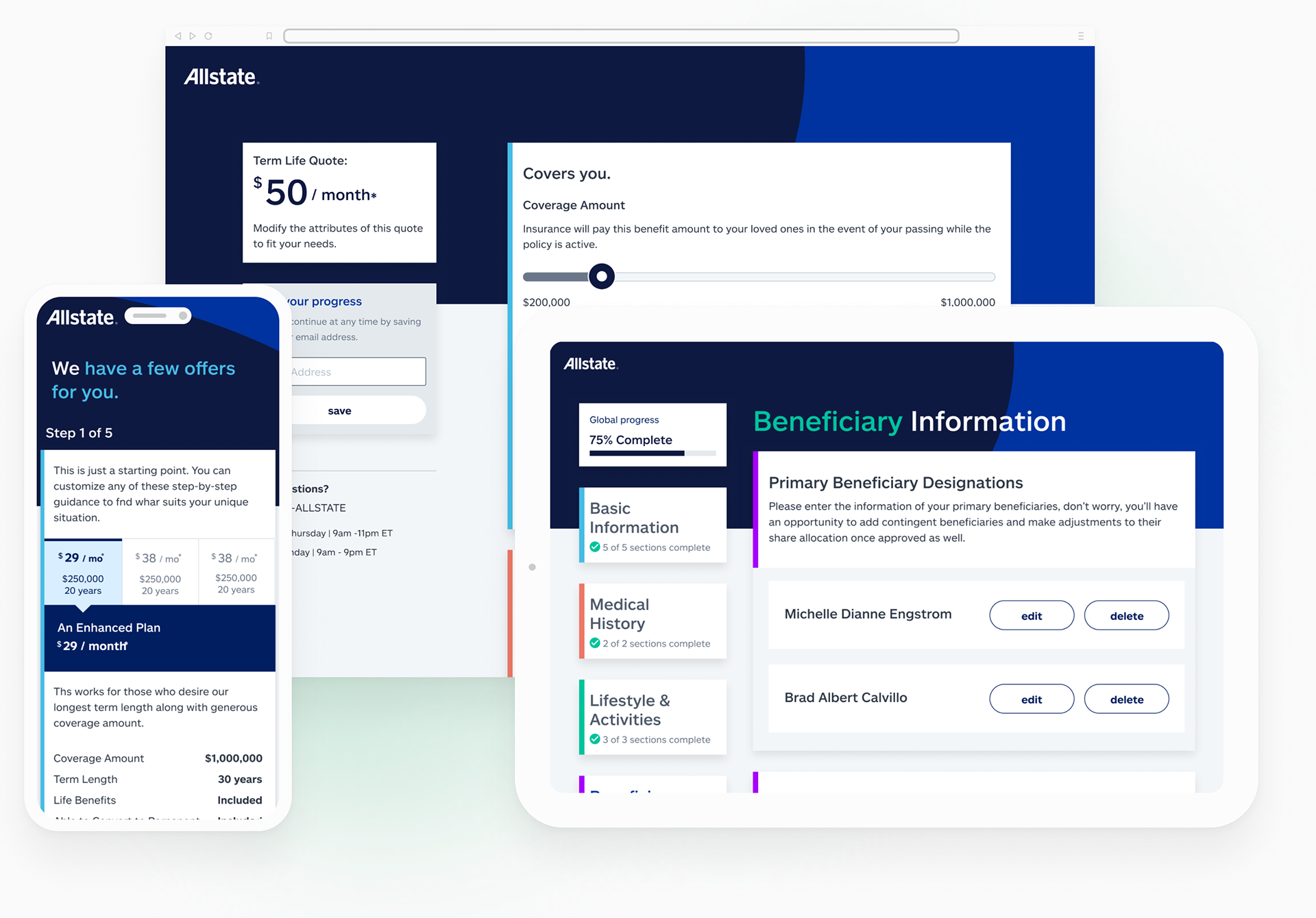
The life insurance application process is inherently high-friction; it starts with the consumer “applying” to purchase a product and often requires users to answer (sometimes literally) hundreds of regulated, invasive questions. My mandate was to transform this daunting requirement into a seamless, trusted digital experience for Allstate life insurance applicants, bridge the gap between Sureify’s core software capabilities and Allstate’s specific brand requirements and user research findings.
Business Case: Beyond fixing the frontend, the goal was to protect the Allstate contract for the initial implementation and launch of our eApp product LifetimeACQUIRE. We were in active talks to provide extensive professional services beyond launch and compliment our eApp product with others in support of Allstate’s online life insurance sales pipeline. The professional services contract alone was well north of two million USD.
Besides the financial side, there were reputations at stake. The Life & Annuity industry in North America is rather small in comparison to other financial services industries. A significantly delayed or failed implementation of a highly sought after product (eApps were all the rage during COVID) would spell disaster for our sales opportunities - especially considering Allstate’s size and reputation.
Business Case: Beyond fixing the frontend, the goal was to protect the Allstate contract for the initial implementation and launch of our eApp product LifetimeACQUIRE. We were in active talks to provide extensive professional services beyond launch and compliment our eApp product with others in support of Allstate’s online life insurance sales pipeline. The professional services contract alone was well north of two million USD.
Besides the financial side, there were reputations at stake. The Life & Annuity industry in North America is rather small in comparison to other financial services industries. A significantly delayed or failed implementation of a highly sought after product (eApps were all the rage during COVID) would spell disaster for our sales opportunities - especially considering Allstate’s size and reputation.
Solution Architecture
I moved the project from "bespoke screen design" to a "component-based whitelabeling strategy."
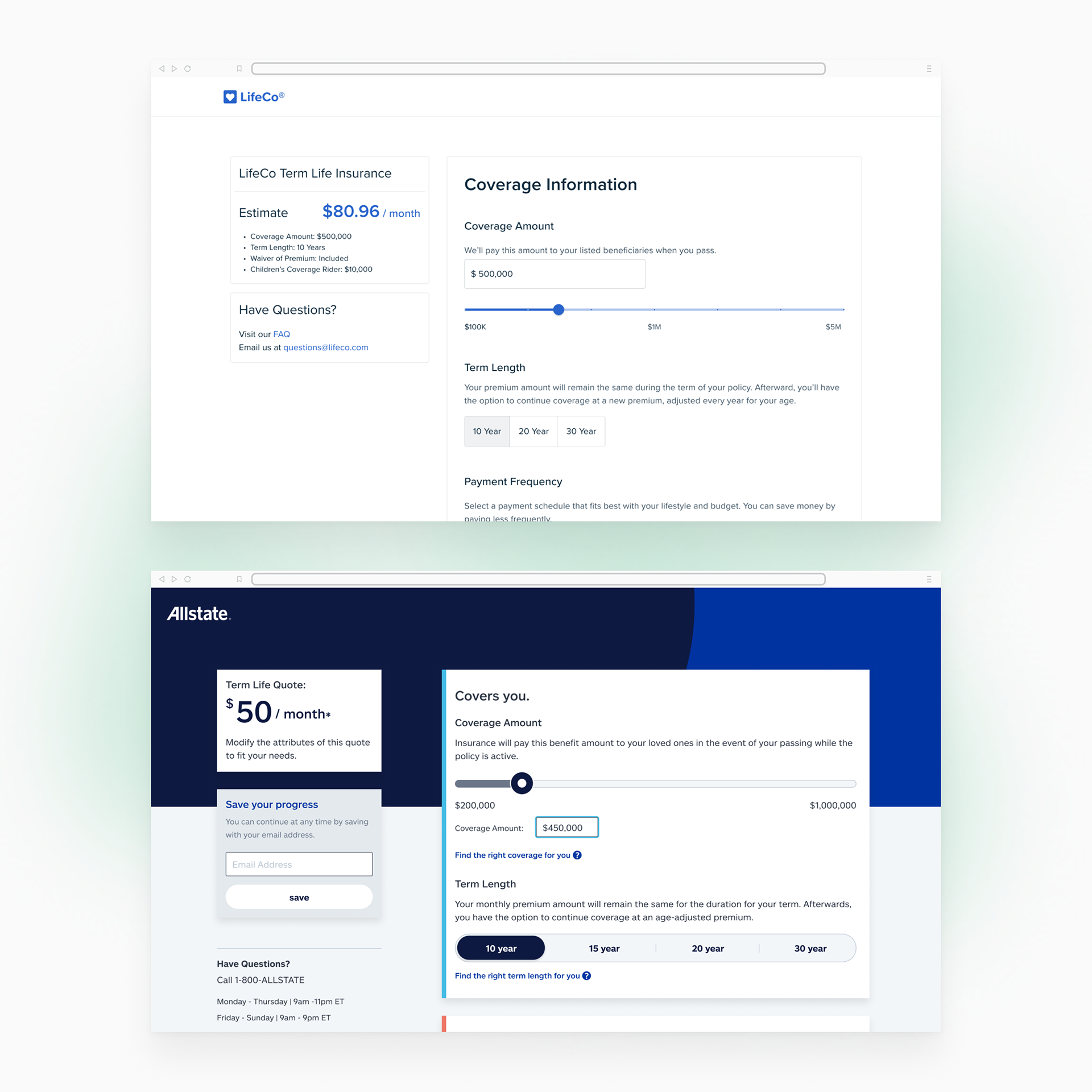
Strategic Whitelabeling: Realizing that manual design for hundreds of logic-based screen variations was inefficient, I focused on identifying and branding "high-impact" key screens and universal UI components (toasts, alerts, dialogs).
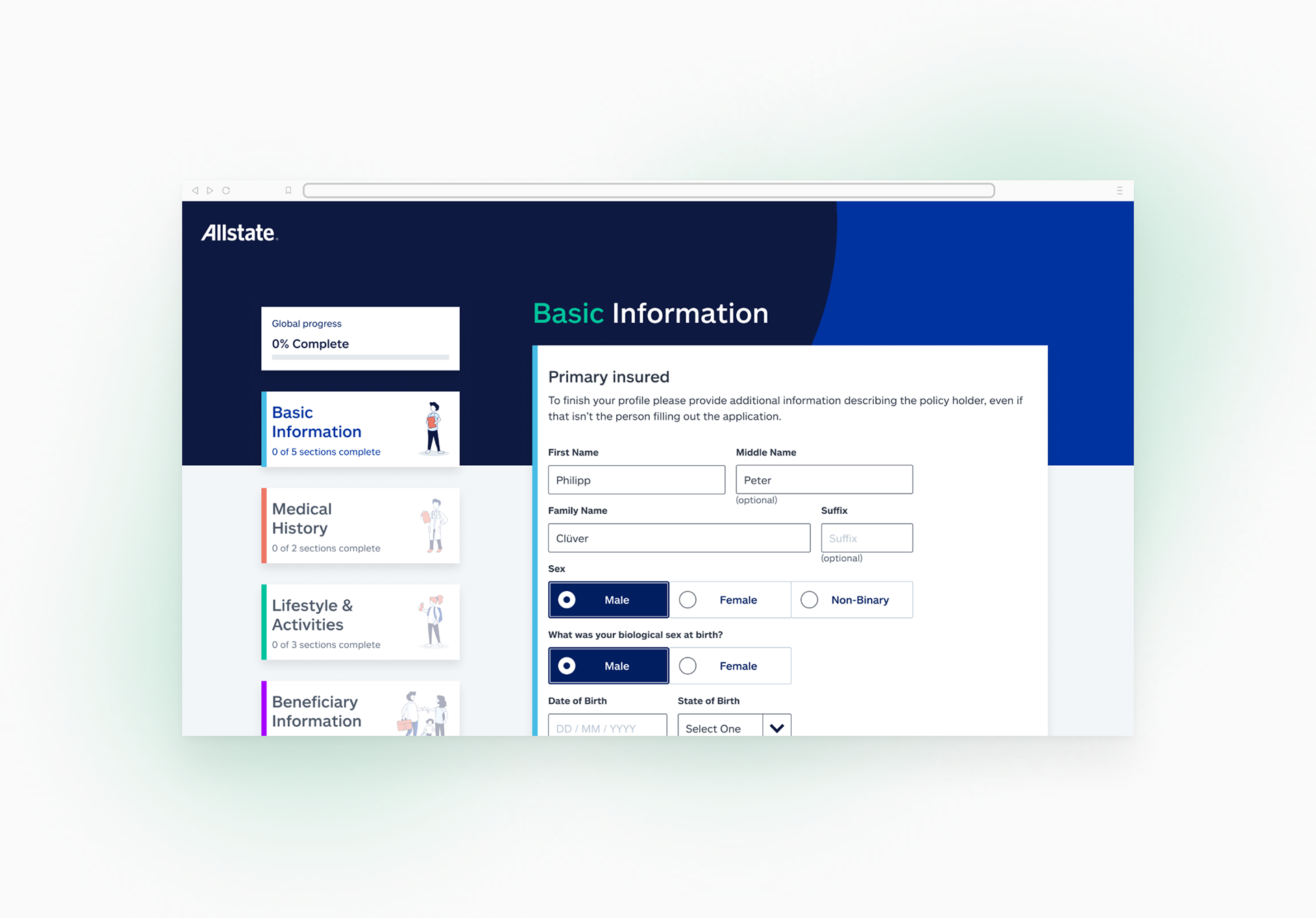
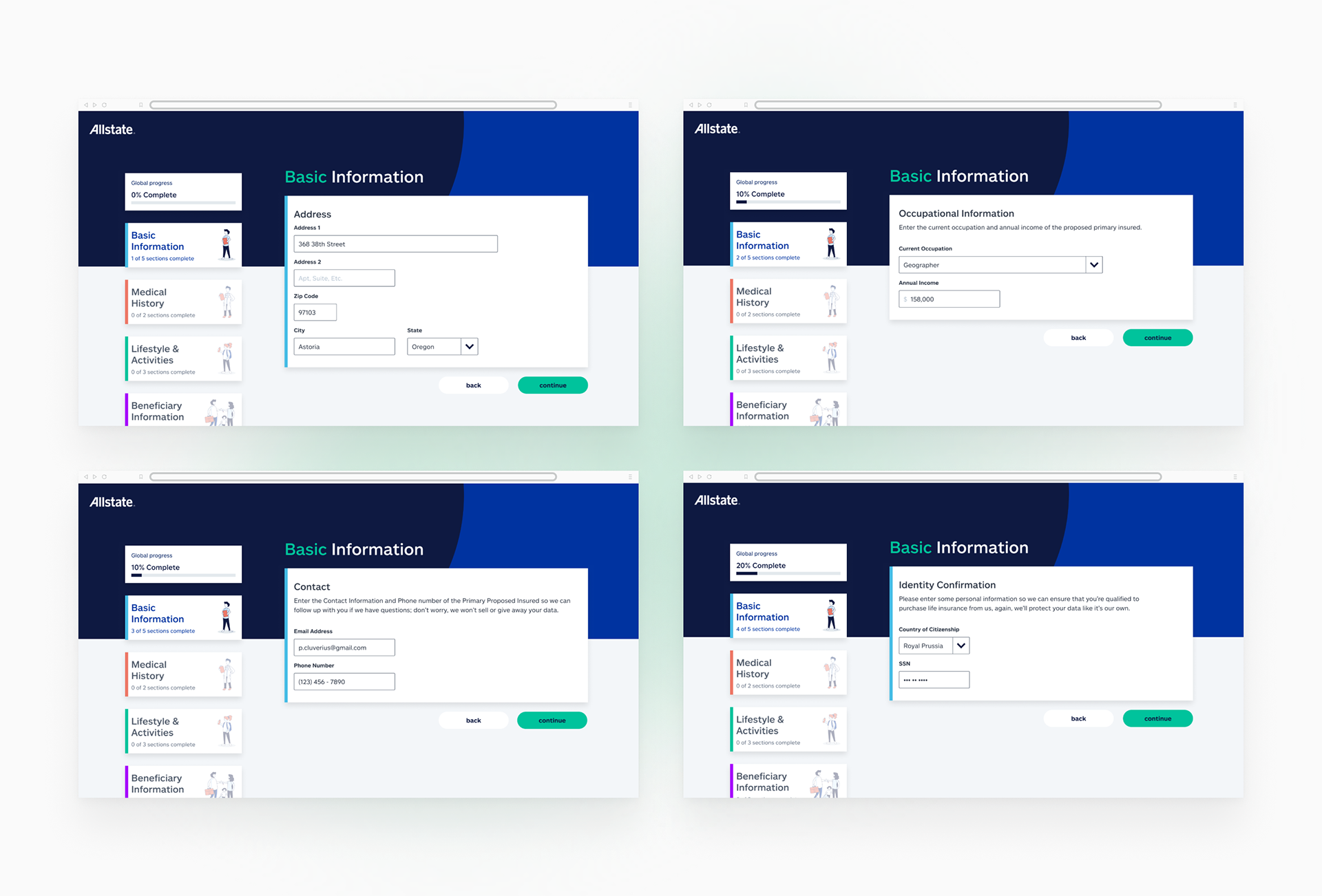
UX Framework (Transparency, Pacing, Deduplication): I implemented a structured two-column layout that provided continuous progress visibility (Transparency), limited cognitive load by showing single questions (Pacing), and reduced user effort by reusing existing data (Deduplication).
Scalable Delivery Practice: I identified the need for a specialized "Delivery Design" role to act as the bridge between Product and Customer Success.
Strategic Whitelabeling: Realizing that manual design for hundreds of logic-based screen variations was inefficient, I focused on identifying and branding "high-impact" key screens and universal UI components (toasts, alerts, dialogs).
UX Framework (Transparency, Pacing, Deduplication): I implemented a structured two-column layout that provided continuous progress visibility (Transparency), limited cognitive load by showing single questions (Pacing), and reduced user effort by reusing existing data (Deduplication).
Scalable Delivery Practice: I identified the need for a specialized "Delivery Design" role to act as the bridge between Product and Customer Success.
The Messy Middle
Upon taking over the account, the project was at a breaking point with "significant QA challenges."
Leadership Intervention: I had to pivot from purely creative work to a high-intensity QA and remediation phase. I authored a comprehensive Design QA report ranking defects by severity, which served as the roadmap for engineering "rescue" sprints.
Refinement & Evolution: Once Allstate accepted our new UAT baseline, I transitioned the product design relationship from "crisis management" to "proactive evolution" based on Allstate’s updated brand guidelines and proprietary research.
One Size Fits Most: During the white labeling and creative process I quickly discovered the edges of what we could achieve without custom work. Certain styling elements (for example the left stroke card adornments) and input types (Allstate’s checkbox designs), could not be achieved with our out-of-the-box UI/UX, and were custom built for the customer.
Leadership Intervention: I had to pivot from purely creative work to a high-intensity QA and remediation phase. I authored a comprehensive Design QA report ranking defects by severity, which served as the roadmap for engineering "rescue" sprints.
Refinement & Evolution: Once Allstate accepted our new UAT baseline, I transitioned the product design relationship from "crisis management" to "proactive evolution" based on Allstate’s updated brand guidelines and proprietary research.
One Size Fits Most: During the white labeling and creative process I quickly discovered the edges of what we could achieve without custom work. Certain styling elements (for example the left stroke card adornments) and input types (Allstate’s checkbox designs), could not be achieved with our out-of-the-box UI/UX, and were custom built for the customer.
Quantitative & Qualitative Impact
The primary impact was the shift from a "failing project" to a "standardized process."
Revenue Protection: Prevented the loss of one of Sureify's most significant enterprise accounts, and paved the way for a deepening partnership generating revenue in excess of two million USD.
Accessibility Milestone: This project served as the catalyst for moving our product designs to WCAG AA compliance, and kickstarted an internal Accessibility Practice Group composed of design, QA and engineering professionals.
Process Standardization: Post-launch, I formalized the "Delivery Design" playbook, which now governs customer onboarding, whitelabeling guardrails, and post-launch support protocols.
Revenue Protection: Prevented the loss of one of Sureify's most significant enterprise accounts, and paved the way for a deepening partnership generating revenue in excess of two million USD.
Accessibility Milestone: This project served as the catalyst for moving our product designs to WCAG AA compliance, and kickstarted an internal Accessibility Practice Group composed of design, QA and engineering professionals.
Process Standardization: Post-launch, I formalized the "Delivery Design" playbook, which now governs customer onboarding, whitelabeling guardrails, and post-launch support protocols.
Retrospective & Next Horizon
This project taught me that enterprise design is as much about operational reliability as it is about user experience.
Key Learnings: Whitelabeling a complex, multi-variant application requires a modular system rather than a screen-by-screen approach. Without the component-level focus I implemented, the project would have remained unscalable.
Next Horizon: The "Delivery Design" practice I established has now scaled into a core part of the organization. As we’ve matured our delivery design practice we’ve seen a significant reduction in the time it takes to “design” onboard a customer. Along with building out a comprehensive design system, we also refactored our LifetimeACQUIRE designs resulting in whitelabeling taking a couple of months to now two weeks at most, whereby most of the time is spent on ensuring customer signoff on brand application.
The next step is to automate the whitelabeling process further by expanding and upgrading the design system tokens. This would enable us to complete a first pass by just updating the stylesheet, something that could be turned into a self-service item for our customers. It would also free up time for our designers, allowing them to focus on the more bespoke design expressions of brand application.
Key Learnings: Whitelabeling a complex, multi-variant application requires a modular system rather than a screen-by-screen approach. Without the component-level focus I implemented, the project would have remained unscalable.
Next Horizon: The "Delivery Design" practice I established has now scaled into a core part of the organization. As we’ve matured our delivery design practice we’ve seen a significant reduction in the time it takes to “design” onboard a customer. Along with building out a comprehensive design system, we also refactored our LifetimeACQUIRE designs resulting in whitelabeling taking a couple of months to now two weeks at most, whereby most of the time is spent on ensuring customer signoff on brand application.
The next step is to automate the whitelabeling process further by expanding and upgrading the design system tokens. This would enable us to complete a first pass by just updating the stylesheet, something that could be turned into a self-service item for our customers. It would also free up time for our designers, allowing them to focus on the more bespoke design expressions of brand application.